Recommended reading
Below you will find a selection of books published by our members that are engaging and easy to read, even for non-experts
Academic publications of LiZZ members are listed here: Publications.
Sprachgebrauch und Sprachidentitäten
Florina Zülli, Ronja Eggenschwiler, Christa Dürscheid (Eds.), 2026
About the book
How does language shape our identity? How do we perform different identities through language? What norms govern our language use—and how do they change over time, depending on the actors involved? What do historical sources reveal about the writers of the past and their writing practices?
This edited volume addresses these and other contemporary questions on the role of language in social and technological transformation processes. It comprises twelve contributions in German and English, which are both theoretical and empirical in orientation, offering fascinating insights into the variability of individual languages and the interrelation between language use and identity.
Link to publisher's website: Sprachgebrauch und Sprachidentitäten
Studienbuch Linguistik
Noah Bubenhofer, Julia Krasselt, Michael Prinz und Hiloko Kato, 2025
Vol 1: Modern Language
About the book
The Studienbuch Linguistik provides a comprehensive introduction to the core areas of German linguistics. Semiotics, semantics, pragmatics, phonetics and phonology, morphology, and syntax lay the foundation, upon which text linguistics, conversation and interactional linguistics, sociolinguistics, language, discourse and culture, as well as empirical methods are built. The volume thus offers a profound overview and reliable guidance for all levels of B.A., M.A., and teacher education programs.
-
Suitable for all stages of university study: B.A., M.A., and teacher training
-
A modern, usage-based introduction to the core subfields of linguistics
-
Combines foundational knowledge of German linguistics with current developments
Link to publisher's website: Studienbuch Linguistik
Sprachenräume der Schweiz

Elvira Glaser, Johannes Kabatek, Barbara Sonnenhauser (Eds.), 2024
Vol 1: Languages
About the book
This handbook offers a comprehensive overview of the diversity of languages and dialects used in Switzerland up to the present day, as well as the spatial and social factors conditioning their occurrence. It goes beyond treating Switzerland merely as a quadrilingual country; instead, it breaks new ground by also incorporating English and languages whose presence in Switzerland stems from migration. Historical languages and dialects spoken within the Swiss and Liechtenstein linguistic areas are covered, as are the three Swiss sign languages. The handbook thus provides an expanded perspective on the spaces occupied by the languages of Switzerland.
Link to publisher's website: Sprachenräume der Schweiz
Syntaktischer Atlas der deutschen Schweiz (SADS)
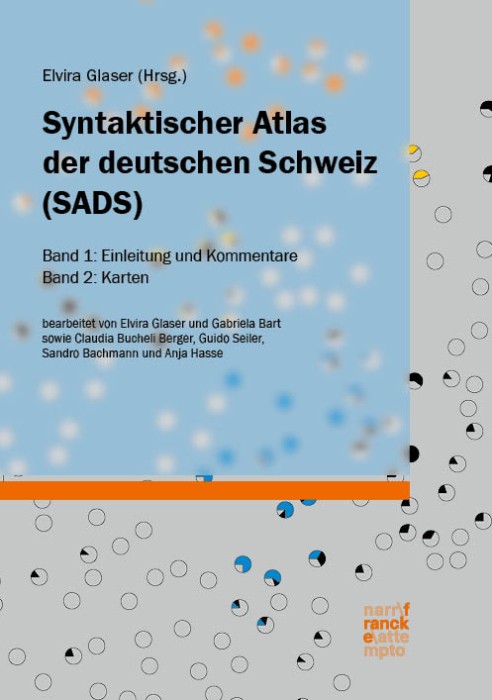
Elvira Glaser (Ed), 2022
Vol 1: Introductions and Comments; Vol 2: Maps
About the book
This two-volume work provides the first comprehensive overview of the syntax of Swiss German dialects. It complements the standard reference work “Sprachatlas der deutschen Schweiz” (Linguistic Atlas of German-Speaking Switzerland), in which syntactic questions were largely omitted. The results presented are based on a survey funded by the Swiss National Science Foundation, which used questionnaires at 383 survey locations with an average of seven informants per location between 2000 and 2002. The atlas presents a detailed view of numerous previously neglected or overlooked phenomena in the syntax of noun and verb phrases, as well as clause combining, and provides evidence for the long-contested regional variations in the field of morphosyntax. Taking local variation into account, the findings are discussed in 78 thematic commentaries (Vol. 1) and presented on 216 dialect maps (Vol. 2), some of which are in color, depending on the map type.
Link to publisher's website: Syntaktischer Atlas der deutschen Schweiz (SADS)
Sprache(n) verstehen
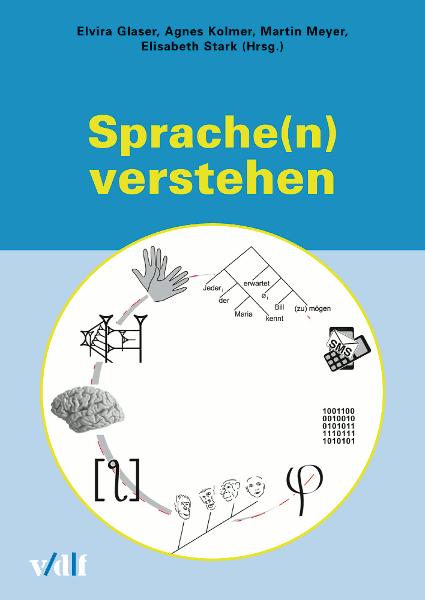
Elvira Glaser, Agnes Kolmer, Martin Meyer, Elisabeth Stark (Eds.), 2014
With contributions from Abraham Bernstein, Balthasar Bickel, Penny Boyes Braem, David Crystal, Knorad Ehlich, Elvira Glaser, Hans-Johann Glock, Walter Haas, Jonathan Harrington, Agnes Kolmer, Martin Meyer, Elisabeth Stark, Christoph Uehlinger, Cornelius Weiller.
Produced in collaboration with ZüKL, the predecessor of LiZZ.
About the book
Language, as a unique capability reserved solely for Homo sapiens, has always fascinated humanity. It forms the foundation of thought, communication, and interaction between individuals and social groups. While spoken and sign languages share similar structural foundations across the globe, they also differ considerably.
Experts from various disciplines explain how research approaches the phenomenon of language from shifting perspectives. Contributions from linguistics, philosophy, neuroscience, evolutionary biology, developmental psychology, and computational linguistics provide fascinating insights into aspects of language diversity, language change, language use, language development, and speech and language disorders. The volume concludes with a contribution on the role of English as the language of science.
Link to publisher's website: Sprache(n) verstehen