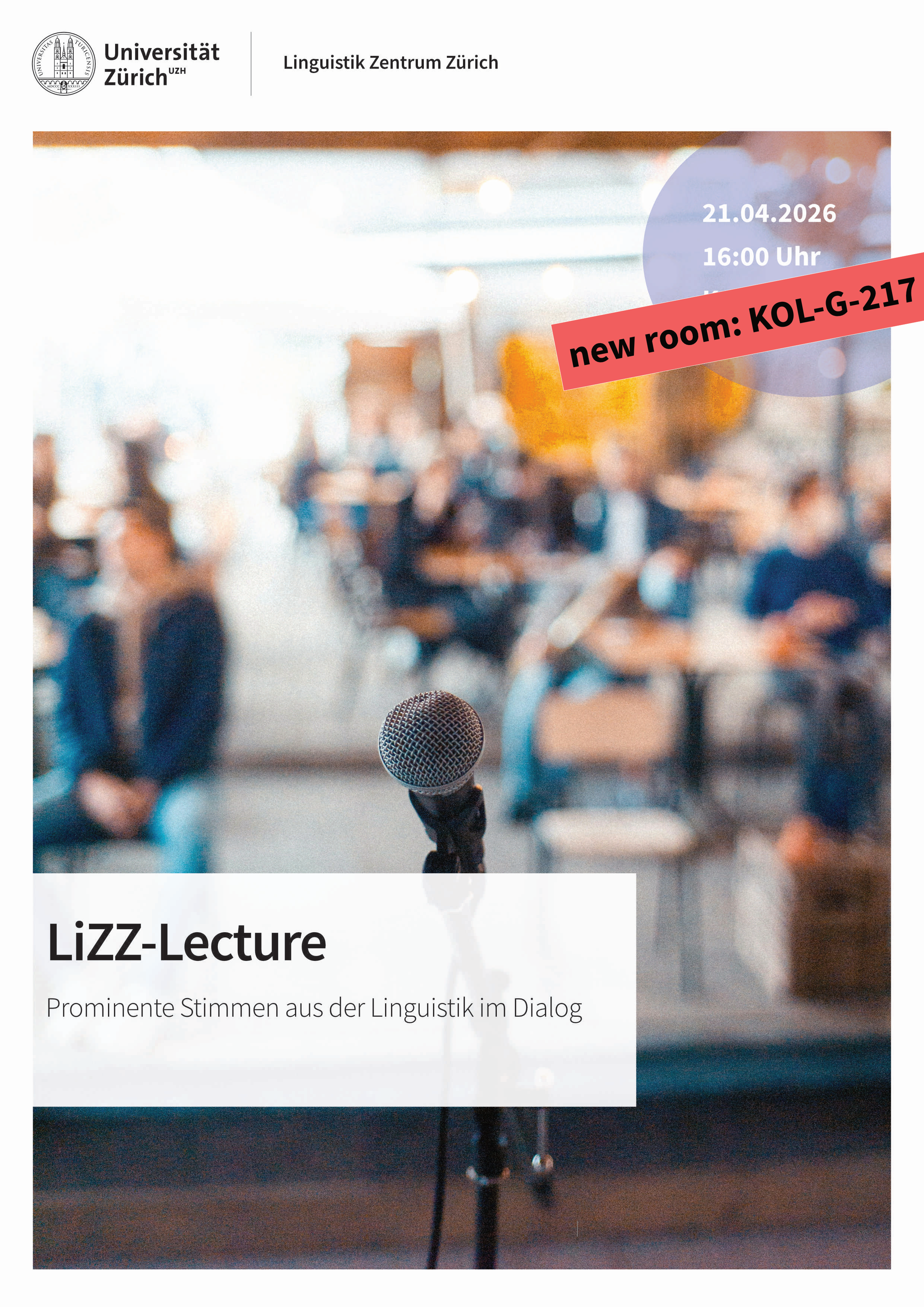
LiZZ-Lecture
Seiteninhalt
Artificial Intelligence and Natural Language
Gastvortrag von Mark Steedman Professor of Cognitive Science, University of Edinburgh
Diskutanten:
Dr. Remo Nitschke, Institut für Interdisziplinäre Sprachevolutionswissenschaft, UZH
Prof. em. Dr.Hans-Johann Glock, Philosophisches Seminar, UZH
Abstract:
Large Language Models have shown remarkable abilities in natural language processing, tempting many to speak of them as if they used and understood language as humans do. However, doing so overlooks the distinction between the structural systems that support meaning and reasoning and the mechanisms for predicting what will come next in a data that LLMs encode. LLMs excel at prediction, and it it is surprising how much can be done by memorization indexed by similarity alone. LLMs can answer abstruse questions, generate text of astonishing fluency on any subject in any style, and generate workable computer code and formal proofs in this way. They will continue to make progress in this way for some time to come.
However, some limitations of LLMs are becoming increasingly clear. They struggle with sound logical inference, they may include convincing yet wholly inaccurate information, and they have difficulty in generalizing code beyond superficial similarity to examples they have encountered during training. This lecture will present recent research that highlights both the capabilities of, and the constraints upon, these systems. Its conclusion will be twofold: that LLMs work in a very different way to humans, and have very little to tell us about the way human beings use language; and that the future of natural language processing lies in hybrid systems that combine the precision and structure of symbolic reasoning with the power of recall and access by similarity of content of neural computation.

Über den Referenten
Mark Steedman ist Professor für Kognitionswissenschaft an der University of Edinburgh (School of Informatics). Seine Forschung bewegt sich an der Schnittstelle von Computerlinguistik, Künstlicher Intelligenz und Kognitionswissenschaft. Er arbeitet unter anderem zur Generierung bedeutungstragender Intonation für künstliche Sprachsysteme, zum kommunikativen Einsatz von Gestik, zu Tempus und Aspekt sowie zu Wide-Coverage-Parsing und robuster Semantik im Rahmen der Combinatory Categorial Grammar (CCG). Darüber hinaus beschäftigt er sich mit computergestützter Musikanalyse und kombinatorischer Logik.
Über die LiZZ-Lecture
Die LiZZ-Lecture bietet international renommierten Expert:innen eine besondere Bühne, um ihre aktuelle Forschung in der Linguistik zu präsentieren. Anstatt eines herkömmlichen Gastvortrags ist jede Veranstaltung als integrierter Dialog konzipiert: Im Anschluss an die Keynote geben ausgewählte Wissenschaftler:innen der UZH fachspezifische Kommentare ab, die die Kernthemen des Vortrags aus der Perspektive ihrer eigenen Forschungsbereiche kontextualisieren.
Dieser mehrschichtige Ansatz verdeutlicht die enge Vernetzung innerhalb unseres Feldes und schlägt Brücken zwischen verschiedenen linguistischen Disziplinen, um eine umfassende Sicht auf das jeweilige Thema zu ermöglichen. Abschliessend öffnen wir die Runde für das Publikum und laden Sie herzlich ein, direkt mit den Referierenden in den Austausch zu treten.
Wenn Sie tiefe Einblicke gewinnen und erleben möchten, wie wissenschaftliche Ideen aus verschiedenen Blickwinkeln beleuchtet werden, laden wir Sie herzlich zur LiZZ-Lecture ein.
Die Veranstaltung ist öffentlich. Alle Interessierten sind willkommen!
Registrierung
Für eine gelungene Organisation des Events und Apéros bitten wir um Anmeldung.
|
Details: |
Datum: 21. April 2026 |